Offerings and sacrifices were nothing new to the Israelites, but some people were abusing sacrifices, so God had to start regulating them (according to bible.org).
Leviticus 3- Fellowship offering (also known as peace offering) was given to God when the Israelites wanted to give thanks to God. These offerings were optional. This sacrifice is similar to the burnt offering, but you can sacrifice either a female or a male animal, but it can't be fowl/poultry.
Leviticus 4- A sin offering had to be given to God if the person unintentionally sinned by breaking one of God's commandments. That person had to sacrifice a young bull that was also free of sin. If the whole community sins, then they have to give an offering of a young bull when they are aware that they have sinned. If a leader sins unintentionally, then he has to bring a young goat (not sure why a goat vs bull. Which one is more valuable?). If it's a member of a community, then that person has to bring a female goat -- not sure what the difference between a member of a community is and the first person.
Leviticus 5- A few sins are listed, and if anyone is guilty of those, then that person must confess his sins and give a burnt offering of a lamb or goat. A grain substitution can be made if he can't afford a lamb or a goat, and then it's carried on like a grain offering. For all other sins, the person must give a guilt offering, but first "he must make restitution for what he has failed to do in regard to the holy things, add a fifth of the value to that and give it all to the priest."
Wednesday, April 28, 2010

Leviticus 1-2, Psalm 90-91
I'll start with Psalm 90-91. There is some debate on who actually wrote these Psalms. Some argue that it was written by Moses, but some say that Psalms is written much later. It seems that our Bible plan thinks it's written by Moses or else we wouldn't be reading it so early!
Psalm 90 is titled a Prayer of Moses, so either it's written by Moses or someone writing from Moses' point of view. This Psalm basically outlines how short our lives are, and how scared we are because God can end our lives at any time. To sum up- he anger of God is upon us. But then the mood in the psalm shifts and it's a lot more optimistic ans uplifting. Moses then says "Satisfy us in the morning with your unfailing love, that we may sing for joy and be glad all our days...May your deeds be shown to your servants, your splendor to their children. May the favor of the Lord our God rest upon us; establish the work of our hands for us."
Psalm 91 is a pretty famous Psalm, and you may recognize the lines from a popular worship song. The shadow of the Almighty will protect all who trusts in him. If people trust in Him completely, then harm will come to them, and God will send his angels to protect them. People won't have to fear anymore because they can live in security through God.
Leviticus 1 describes how the burnt offering should be carried out, and Leviticus 2 lays out the process for the grain offering. The burnt offering has to be from a perfectly healthy male animal. Steps are describes on how to prepare the animal for the offering. For the grain offering, only a handful is ceremonially burnt, and the rest is given to Aaron and the other priests.
Psalm 90 is titled a Prayer of Moses, so either it's written by Moses or someone writing from Moses' point of view. This Psalm basically outlines how short our lives are, and how scared we are because God can end our lives at any time. To sum up- he anger of God is upon us. But then the mood in the psalm shifts and it's a lot more optimistic ans uplifting. Moses then says "Satisfy us in the morning with your unfailing love, that we may sing for joy and be glad all our days...May your deeds be shown to your servants, your splendor to their children. May the favor of the Lord our God rest upon us; establish the work of our hands for us."
Psalm 91 is a pretty famous Psalm, and you may recognize the lines from a popular worship song. The shadow of the Almighty will protect all who trusts in him. If people trust in Him completely, then harm will come to them, and God will send his angels to protect them. People won't have to fear anymore because they can live in security through God.
Leviticus 1 describes how the burnt offering should be carried out, and Leviticus 2 lays out the process for the grain offering. The burnt offering has to be from a perfectly healthy male animal. Steps are describes on how to prepare the animal for the offering. For the grain offering, only a handful is ceremonially burnt, and the rest is given to Aaron and the other priests.
Monday, April 26, 2010
Exodus 36-40

The Israelites who had been chosen by God to build the tabernacle (Bezalel, Oholiab and others) were given craftsmans skills. Moses summoned people to come help both with building (if they had the skills) and providing materials (through freewill offerings). Amazingly, the Israelites continued to bring offering after offering until Moses had to tell them to stop because there was already enough material.
Bezalel, Oholiab and the other skilled workers began building all the parts of the tabernacle, the Ark, the table, the lampstand, altars, basins for washing, the courtyard, and all the priestly garments (ephod and breastplate) exactly to God's specifications (as outlined earlier in the chapter).
Moses inspected their work, saw that it was good and to God's specification, and he blessed them. God then gave them explicit instructions on how to set it up. When this all done, a cloud covered the Tent of Meeting and the glory of the Lord filled the tabernacle. No one could enter while the Lord was there.
As they went along on their journey, they would always wait until the cloud lifted from above the tabernacle. Then they would pack up and move. By day, the cloud was above the tabernacle, by night, it was a flame.
Some Useful Background Information
Tabernacle: a portable "dwelling place" for God, and derives from the Latin word tabernaculum, which means "tent." Interestingly, most Jewish synagogues in the last 2000 years have been inspired and/or modeled off of this ancient description of the tabernacle in the Bible!


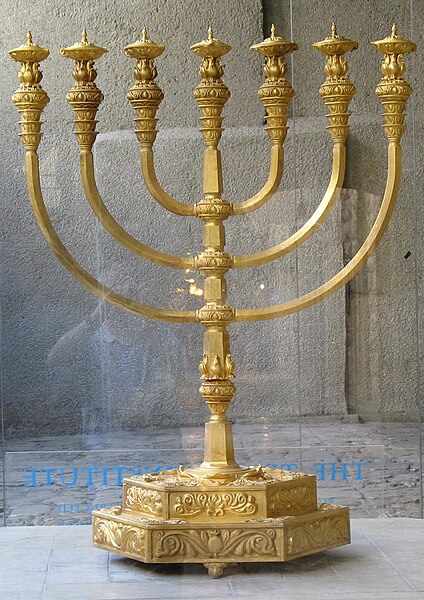
Lampstand: if you read the description of the lampstand, it sounds like the Jewish menorah.
Six branches extended from the sides of the lampstand—three on one side and three on the other.
Sunday, April 25, 2010
Exodus 33-35
So God told Moses to lead the people to the promised land flowing with milk and honey. The Lord, however, will not go with them because they are a "stiff-necked" people and He might just be angry and destroy them on the way. It's quite distressing to hear of God's anger on the people!! But even though the people committed the greatest sin (worshipping man-made gods!) - God extended His grace and promised to send an angel to be with them to protect them along the way.
Now the tent of meeting is where Moses talked to God. it's quite amazing to see how God actually could talk to Moses "as a man speaks with his friend". Moses boldly asked God to continue to show him favor - and asked God to show His glory. God said that no one could see his face or they would die - but He would let Moses see his back...
God also told Moses to bring 2 more stone tablets so that He could write again the commandments. As God passed by Moses, He proclaimed his compassion and grace and love and faithfulness - but also stated that he would not leave the guilty unpunished.
Moses pleaded to God to forgive the people's sin and wickedness, to which God has made yet another covenant--that He would drive out all the pagans, but the Israelites were not to worship any other Gods, for the Lord, whose name is Jealous, is a jealous God. (NB: I thought it was an interesting choice of word to describe God is a jealous God.) Then God told them how to celebrate the Passover, how to observe the Sabbath, and how people are to bring the first fruits of their soil to the Lord.
So Moses was with God for 40 days and 40 nights (without eating and drinking), writing down the 10 commandments. When Moses came back down from Mount Sinai, his face was radiant because he met with God. So he put a veil on him when he spoke with the people.
Moses told the people about the Sabbath, and he also told what God commanded: for all the skilled and willing-hearted to make the tabernacle the way that God has envisioned/designed. (NB: I didn't detail how the design of the tabernacle would be - but I did a Sunday school class before on the tabernacle, using this model: http://www.the-tabernacle-place.com/) It's actually quite amazing how every little thing has a meaning to it!)
Now the tent of meeting is where Moses talked to God. it's quite amazing to see how God actually could talk to Moses "as a man speaks with his friend". Moses boldly asked God to continue to show him favor - and asked God to show His glory. God said that no one could see his face or they would die - but He would let Moses see his back...
God also told Moses to bring 2 more stone tablets so that He could write again the commandments. As God passed by Moses, He proclaimed his compassion and grace and love and faithfulness - but also stated that he would not leave the guilty unpunished.
Moses pleaded to God to forgive the people's sin and wickedness, to which God has made yet another covenant--that He would drive out all the pagans, but the Israelites were not to worship any other Gods, for the Lord, whose name is Jealous, is a jealous God. (NB: I thought it was an interesting choice of word to describe God is a jealous God.) Then God told them how to celebrate the Passover, how to observe the Sabbath, and how people are to bring the first fruits of their soil to the Lord.
So Moses was with God for 40 days and 40 nights (without eating and drinking), writing down the 10 commandments. When Moses came back down from Mount Sinai, his face was radiant because he met with God. So he put a veil on him when he spoke with the people.
Moses told the people about the Sabbath, and he also told what God commanded: for all the skilled and willing-hearted to make the tabernacle the way that God has envisioned/designed. (NB: I didn't detail how the design of the tabernacle would be - but I did a Sunday school class before on the tabernacle, using this model: http://www.the-tabernacle-place.com/) It's actually quite amazing how every little thing has a meaning to it!)
Friday, April 23, 2010
Exodus 31-32
The Lord instructs us to observe the Sabbath beacuse it is a holy day and doing work on that day will result in death (but this is the old testament laws right?) Israelites were instructed to obey the Sabbath for generations to come.
So Chill out and Relax on Sunday and Rest =)
Moses went up to the mountain to get the tablet. the people he led did not know if he was coming back. Aaron gathered all the gold and made idols out of them for them to worship. They started worshiping the idols and made God angry. He was going to destroy them. Moses however pleaded on their behalf and asked Him to remember the servants he promised he will give numeours descendants. God relented and did not destroy the idol worshippers.
When Mosses himself saw the worshippers going amok, he too was very angry. He rallied his troops that were with the Lord and destroyed sent them out to kill those who were against the Lord. Mosses asked for forgiveness on behalf of the idol worshippers and God promised to be with him and his people as they go to the promise land.
So Chill out and Relax on Sunday and Rest =)
Moses went up to the mountain to get the tablet. the people he led did not know if he was coming back. Aaron gathered all the gold and made idols out of them for them to worship. They started worshiping the idols and made God angry. He was going to destroy them. Moses however pleaded on their behalf and asked Him to remember the servants he promised he will give numeours descendants. God relented and did not destroy the idol worshippers.
When Mosses himself saw the worshippers going amok, he too was very angry. He rallied his troops that were with the Lord and destroyed sent them out to kill those who were against the Lord. Mosses asked for forgiveness on behalf of the idol worshippers and God promised to be with him and his people as they go to the promise land.
Thursday, April 22, 2010
Exodus 29-30
Exodus 29 starts by describing procedure to ordain and consecrate Aaron's line as priests. Then the chapter describes how to do sin offering, burnt offering, wave offering, and fellowship offering. Only the ordained priests can eat the ram and bread made for ordination and offering. God was very specific about how to make the altar holy and consecrated, and how frequent the offerings are to be done. He promises that as these instructions are followed, He would dwell among the Israelites and the tent of meeting will be consecrated.
Exodus 30 continues with the specific instruction about the altar where incense is to be burned. Every day the priest will have to burn a specific incense twice, once in the morning and once at twilight. Annual atonement also needs to be done (for sin). Every Israelite over twenty years old has to pay half shekel as an offering to God. For atonement of life, everyone, no matter how rich or poor, would give the same amount. This amount will be used for service of tent of meeting.
God also instructed them to make a bronze basin for priests to wash their feet and hands as they would not die. God also tells them specific formulas to make anointing oil and incense - the same formula is considered as "holy". Using these things as enjoyable items (e.g. as perfume or as something to "enjoy fragrance) is prohibited.
Exodus 30 continues with the specific instruction about the altar where incense is to be burned. Every day the priest will have to burn a specific incense twice, once in the morning and once at twilight. Annual atonement also needs to be done (for sin). Every Israelite over twenty years old has to pay half shekel as an offering to God. For atonement of life, everyone, no matter how rich or poor, would give the same amount. This amount will be used for service of tent of meeting.
God also instructed them to make a bronze basin for priests to wash their feet and hands as they would not die. God also tells them specific formulas to make anointing oil and incense - the same formula is considered as "holy". Using these things as enjoyable items (e.g. as perfume or as something to "enjoy fragrance) is prohibited.
Exodus 27-28
Now they are to make an altar of burnt offering, but this altar is to be hollow and made out of boards. The instructions are just as detailed as before.
Then they are instructed to make a courtyard with curtains. Also, everything else used in the tabernacle need to be made of bronze.
He tells Moses to tell the Israelites to bring olive oil for the lamps (ooh must smell good!). In the Tent of Meeting, Aaron and his sons are told to keep the lamp burning throughout the night. Him and his sons are to serve as priests. God says that all the skilled men are to make sacred garments for Aaron to give him dignity and honor. He's to wear "a breastpiece, an ephod, a robe, a woven tunic, a turban and a sash. They are to make these sacred garments for your brother Aaron and his sons, so they may serve me as priests." An ephod is a priestly vest, and it closely resembles the shape of an apron. God goes into detail again about how the garments should be made.
What's strange is that God directs Moses to put the clothes on Aaron and his sons, consecrate them so they can serve as priests, and then make linen undergarments. Shouldn't the undergarments be made first and worn first??
Aaron and his sons have to wear the sacred garments "whenever they enter the Tent of Meeting or approach the altar to minister in the Holy Place, so that they will not incur guilt and die. This is to be a lasting ordinance for Aaron and his descendants." Die? What??
Then they are instructed to make a courtyard with curtains. Also, everything else used in the tabernacle need to be made of bronze.
He tells Moses to tell the Israelites to bring olive oil for the lamps (ooh must smell good!). In the Tent of Meeting, Aaron and his sons are told to keep the lamp burning throughout the night. Him and his sons are to serve as priests. God says that all the skilled men are to make sacred garments for Aaron to give him dignity and honor. He's to wear "a breastpiece, an ephod, a robe, a woven tunic, a turban and a sash. They are to make these sacred garments for your brother Aaron and his sons, so they may serve me as priests." An ephod is a priestly vest, and it closely resembles the shape of an apron. God goes into detail again about how the garments should be made.
What's strange is that God directs Moses to put the clothes on Aaron and his sons, consecrate them so they can serve as priests, and then make linen undergarments. Shouldn't the undergarments be made first and worn first??
Aaron and his sons have to wear the sacred garments "whenever they enter the Tent of Meeting or approach the altar to minister in the Holy Place, so that they will not incur guilt and die. This is to be a lasting ordinance for Aaron and his descendants." Die? What??
Subscribe to:
Posts (Atom)